Sunday, March 23, 2014
*Ch16-19 (H)
The "circularity" illustrated in chapter 17 is a cycle of civilization, for each family that camps along the side of the road begins as one, and eventually moves to accommodate for another while receiving similar treatment in return. "Every night relationships that make a world established" (Steinbeck 194) - is is such actions of similar treatment that creates these worlds. Equal treatment of each other united under a single, flexible concept of lawfulness for community, seen in a way not so different from Casy's new revelations of transcendentalism creates a fluid base for each camp. The first family finds the campground. The second family is given shelter by the first. A third family receives shelter, and perhaps a giving or trade of resources driven by said ideals of law and duty to the group begins to start. And so a fourth family, a fifth family, and many more fit into this motion as long as they are of similar mind to the first few families. Thus, "as the worlds moved westward, rules became laws, although no one told the families" ) Steinbeck (194), since these rules-that-become-laws are established more and more firmly with each encampment. A family that was unfamiliar with the culture of the camps would become one that was in order to survive. However, the laws of the camps are different from that of government; the camps, created through the belief in one's duty to the entire pack is just thus, and so brings prosperity to all - else there would be unsatisfied migrants who avoid the camps. The government is instead described as a "monster", a bank that grabs land, controlled by the few in power. The government protects the people already in a solid position in California against the so-called "Okies"; the circularity shown in chapter 17 is thus of not only an illustration of the rise of civilizations, but also of the difference between the results of governmental interest.

Tuesday, March 18, 2014
*Ch16-19 (C)
My point of view is that although these straggling migrants may form communities along their road to California, they will still be competition for each other upon arrival. While they may accommodate for each other even then, the fact remains that the mere presence of others seeking work makes it that much harder to obtain food. Therefore my theme is thus; bad farming, although unrealized, tore down all or most farmers in the Dust Bowl. The survivors of the journey and stay in California will eventually be integrated into it's society.
--
Still, upright, a stone sits primly on a hill
A push, a shove, a force; the stone rolls
Down, falling, the hill seems only to recede
A bump, a touch, a force; more stones spill
Thud, impact, they flock yet descent takes a toll
A crash, a bounce, a roll; stones land, bleed
They continue to plummet.
Impact, crumble, stones continue to cascade down
They break, they shatter; new stones damage the fallen
Sweep, roar, air disperses sand - the wind has blown
They spread, they drift; stones no longer still exist
Sand, in time, joins with the rest of the planet.
*Ch11-15 (H/F)
There exists, within the idea of the movement of Transcendentalism, the idea of the individual - that is to say, the statement of one acting upon one's own worth, to refuse to intrude on the other. And so a true individual, a person who is truly self reliant will ascertain himself to his own moral compass; the result of this being that if we ascertain the stance that like minded individuals band together, than said self reliant people will thus form true communities. A described community of this sort would, due to having been created of like minded individuals who require work of themselves and thus upon and for others, be almost an altruistic one. Since each individual would be unwilling to receive help, each individual would instead offer help. With enough time, action would thus arise from the previously defined inaction; this action would be of each towards another, creating a harmonious community free of self interest - instead, it is "self-reliant" and ungoverned by written law.
Steinbeck proposes this very idea - along with an extension of it - in this section. Often seen in dialogue between the Wilsons and the Joads, the two groups, mainly the Wilsons, refuse help from each other in statement but choose to receive it regardless due to necessity: "Wilson said, "Seems like it's my fault. This here goddamn wreck's give me trouble right along. You folks been nice to us. Now you just' pack up and' get along...we'll figger some way. We don't aim to put you folks out none."" (Steinbeck 167). This is repeated again and again - the Wilsons as an entity, along with it's two members exemplify the behavior of an individual; they state that will rely on themselves when Wilson states "we'll figger some way", while acknowledging that the Joads "been nice to" the Wilsons. When the Joads reply saying "We ain't a gonna do it." right back to them, the example of action towards another instead of oneself is also exemplified. Since the two groups go right along together, the "self-reliant" community of before is created. Steinbeck's extension of this idea is a tad more subtle. Throughout the entire text the Transcendental community is juxtaposed with the corporate one, or the government, ruled by the elite few with written, binding law. The second statement Steinbeck tries to make is thus that the Transcendental community of harmony and near altruism (if not altruism already) is far more welcoming to the population than the one with which it is juxtaposed - a white dot on a black background is far more noticeable than a white dot on a grey or white background; the government being the black. After all, the government has served only to strip the farmers of their land due to economic need - the stark contrast of the migrant communities continues to serve one another despite them all being in a time of depression and need - is this not far more human?
Steinbeck proposes this very idea - along with an extension of it - in this section. Often seen in dialogue between the Wilsons and the Joads, the two groups, mainly the Wilsons, refuse help from each other in statement but choose to receive it regardless due to necessity: "Wilson said, "Seems like it's my fault. This here goddamn wreck's give me trouble right along. You folks been nice to us. Now you just' pack up and' get along...we'll figger some way. We don't aim to put you folks out none."" (Steinbeck 167). This is repeated again and again - the Wilsons as an entity, along with it's two members exemplify the behavior of an individual; they state that will rely on themselves when Wilson states "we'll figger some way", while acknowledging that the Joads "been nice to" the Wilsons. When the Joads reply saying "We ain't a gonna do it." right back to them, the example of action towards another instead of oneself is also exemplified. Since the two groups go right along together, the "self-reliant" community of before is created. Steinbeck's extension of this idea is a tad more subtle. Throughout the entire text the Transcendental community is juxtaposed with the corporate one, or the government, ruled by the elite few with written, binding law. The second statement Steinbeck tries to make is thus that the Transcendental community of harmony and near altruism (if not altruism already) is far more welcoming to the population than the one with which it is juxtaposed - a white dot on a black background is far more noticeable than a white dot on a grey or white background; the government being the black. After all, the government has served only to strip the farmers of their land due to economic need - the stark contrast of the migrant communities continues to serve one another despite them all being in a time of depression and need - is this not far more human?
Wednesday, March 12, 2014
Ch11-15 (B)

Also known as the Main Street of America, the Mother Road, the Will Rogers Highway, Route 66 was one of the first highways to be built - on November 11, 1926.
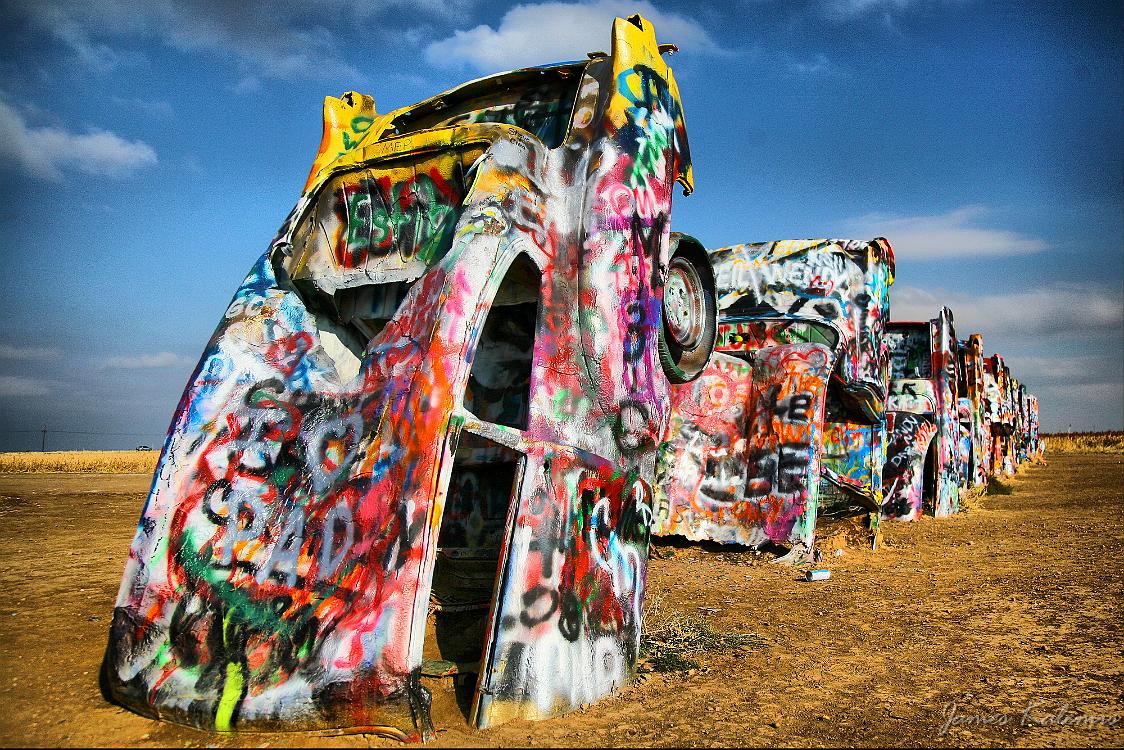
Always, Route 66 is of a moving and changing America.

It is therefore of symbolic reason that Steinbeck includes the route as the one which the Joads travel on - and not just of historic relevance. The Great Depression led up to WWII, which brought about great changes, and the travel of the Joads is one that will be marked with changes, such as in gender roles between the characters of Ma and Pa.
Thursday, March 6, 2014
Ch1-10 (G)
In the time of the Great Depression, many had to decide whether they would fend for their families, or for the good of society. For those without families, the choice was between self and society. Nonetheless, such a choice would be a hard one; either choice would bring about rejection from some parts of each faction.
"I got a wife and kids. We got to eat. Three dollars a day, and it comes every day."
"That's right, the tenant said. But for your three dollars a day fifteen or twenty families can't eat at all."
(Steinbeck 37)
Here, the conflict is clear. The first person, who is the tractor driver running over houses, has clearly chosen his family, and here he earns rebuke from society, as he has abandoned them. The tenant applies utilitarianism, while the driver's actions are arguably more selfish, but still sensible, especially when applying the theory of evolution. (Which states that one will work to pass on one's genes)
"Times are changed...Thinking about stuff like that don't feed the kids."
"Nearly a hundred people on the road for your three dollars."
Again, the same conflict; the same response and reasoning.
As the story develops, the theme of utilitarianism makes itself apparent in a positive light. Always the optimum number is chosen - only one dog of two is taken with the Joads on their journey, while a preacher is brought along, because he appears to be more useful. The tenants believe that the tractor driver should work for the good of society, and not for himself. And all over the Dust Bowl, brokers buy items and memories and sentimental value from poor farmers forced to sell treasured goods for low prices - all for profit, all for themselves, because to them, the optimum benefit is achieved this way. The same with the tractor driver, as to him the weight of his family is worth more - and thus the optimum number is achieved.
Ch1-10 (H)

Gray, Red, Pink, Pale, Green, and Brown. Steinbeck's color imagery in the very first paragraph of his book illustrates information about the dust storms and the gloomy mood brought over the land. All colors mentioned, with the exceptions of pink and brown, are repeated for a total usage count of at least two. Two of them - red and gray - are representative of the locations where dust storms would originate: "By 1934, the storms were coming with alarming frequency. Residents believed they could determine a storm’s point of origin by the color of the dust — black from Kansas, red from Oklahoma, gray from Colorado or New Mexico." Thus the setting is given to the reader right away, and one can know that the story takes place in Oklahoma; The "Red Country" refers to red dust from Oklahoma, and the passage explicitly mentions the state as gray. But if gray is not referring to Colorado or New Mexico, then it must refer to perhaps a connotation of the color. Gray indicates a feel of gloom, or lack of emotion, but not in the dark way of black. Pale evokes a similar emotion, but can also represent death; death of the land, since the topsoil, or "skin", is being blown away, much like how a body first begins its noticeable moments decay from the skin. Pink represents a lack of willpower, and as such, the farmers have begun to give way and evacuate their loved lands. Green and brown require each other in this paragraph; Green is of life, and brown is decay of green and thus decay of life. Thus brown only appears after the first instance of green. Color thus sets the tone for the location that the story is to take place in.
Wednesday, March 5, 2014
Ch1-10 (D)
In the 1930s, horse pulled vehicles were still often used over motorized vehicles - farmers were, after all, short on money. It was only during and after the great migration of "Okies" to California, did the use of automobiles become more widespread. One could argue that the tractor could be seen as a counterexample for that statement, but the tractor was not created for transport, the tractor was not very fast, and the tractor was just as expensive and not all farmers had one - much like the Joads, it seems, lacked a tractor or car. But what kinds of cars DID exist? The largest 3 companies/brands producing automobiles for the primary purpose of transportation at the time were Ford, Chrysler, and General Motors. Ford, the car company named after the inventor of the production line himself, specialized in the idea of reliability. Their cars were supposed to be hardy and would last a while, and Henry Ford only released variations of cars rather reluctantly in response to General Motors. Creating a large variety of cars to suit a larger spectrum of consumers, including kinds known today like the Buick or Chevrolet. This was quite the effective strategy for the market, and General Motors caught up to Ford in sales quite quickly. Chrysler, on the other hand, was just as steady as the other two companies - they acquired Dodge to open up their lineup in 1929, and still was able to turn decent profits with what models they already had. Cars were not all that often used among farm folk in the 1930s due to financial problems, until movement became necessary in the Dust Bowl. Even then, they could only purchase the more run down cars, although there were 3 main producers of this product of the automobile.

But the kinds of hyperlinks you want are here:
Source1 Source2
Sunday, March 2, 2014
Ch1-10 (A)

The Dust Bowl formed during an economic downturn known as the Great Depression; while this crisis is often known to many as simple another stock market crash, the extent of the Depression could not have been, and was not, caused by crash alone. Many crashes had happened in the history of America, causing several depressions, but the Great Depression - the Great exists to emphasize how much worse this depression was. Worsened by not only the Dust Bowl, the Depression deepened when a Federal Reserve Board that thought less money in circulation would result in more careful spending increased interest rates, and when the Hawley-Smoot Tariff act was passed. The tariff was passed to protect farmers (such as the Joads themselves, despite being fictional characters) - the aftermath of World War I meant that Europe began to recover in the area of agriculture, thus reducing demand for U.S. produce. But the tariff was an increase of 8% on not only farm goods, but a multitude (925) of other products. Other countries responded similarly by raising their own tariffs, and so, international trade was quite stunted for America. And this meant that the tariff hurt farmers! The Joads were probably already suffering before that tractor crushed their house. And how ironic that it did; the tractor was originally meant to increase production (which it did) in order to provide farmers with more crops to sell. But with too many crops, the competitive pricing that followed meant lower profits overall.
Source: Liberty, Equality, Power. A History of the American People. 6th edition.
It is a book.


Subscribe to:
Posts (Atom)